
The War on Interiority
Why the most powerful men in the world hate introspection


There is an odd trend unfolding in today’s world — the people with the most power to shape our future are competing to know themselves less.
In a recent interview, billionaire investor Marc Andreessen proudly declared that he aims for “zero” introspection, adding that “great men of history didn’t sit around doing this stuff” and that people who dwell on the past simply get stuck there. While Andreessen’s comments were widely ridiculed, some came to his defense, arguing that he was speaking out against negative rumination. Among those defending him was Elon Musk, who posted that “reinforcing negative neural pathways via therapy or introspection is a recipe for misery.”
The argument against rumination — or “Bad Therapy,” well documented in the book of the same name — is worth taking seriously. If your introspection is merely stewing in negative thoughts, it is unlikely to produce anything generative. If your therapist encourages such forms of introspection, it may actively worsen your mental health.
But these arguments, while not without merit, function as strawmen when wielded as a blanket attack on inner work. They mistake the misuse of introspection for introspection itself, and in doing so, fail to account for the countless ways that therapy, self-reflection, and genuine inner work can be transformative.
Declaring that “great men of history didn’t sit around doing this stuff” is not a critique of rumination. It is a wholesale dismissal of self-examination itself, one that collapsed almost immediately under scrutiny, given that Marcus Aurelius, Abraham Lincoln, and many of the greatest leaders in history were astute self-examiners.
When critics pushed back, rather than clarifying his position, Andreessen doubled down, defining introspection as “neuroticism x narcissism x thumbsucking” and dismissing his critics as navel-gazers. One observer noted that watching the podcast clip makes clear Andreessen treats introspection and guilt as synonymous, suggesting not a careful distinction but a broad and revealing allergy to inner life altogether.
While hyper-criticism and self-absorption are potential failure modes of introspection, they are not the complete story of what the inward turn can offer.
What Is Introspection Anyway?
Introspection is closely associated with intrapersonal intelligence, which encompasses meta-cognitive awareness, self-concept and identity, emotional attunement, and reflective thinking. Together, these deepen one’s understanding of how past experiences, values, and thought processes shape who we are.
Andreessen erroneously connects introspection with narcissism. In reality, those with Narcissistic Personality Disorder tend to lack genuine self-awareness, have poor emotional literacy, and display weak metacognitive awareness, all of which are deficits of intrapersonal intelligence. In this sense, advocating against introspection essentially encourages people to remain unaware of their own narcissistic patterns.
How we relate to different aspects of ourselves also proves foundational in developing interpersonal intelligence, our ability to genuinely relate to others. Introspection is a prerequisite for better relationships, a facet of life that many overlook, yet is continuously reported by those near the end of their lives as what matters most.
Taken far enough, introspection eventually evolves into what we might call spiritual contemplation. At that point, it is no longer simply about understanding yourself or improving your relationships. It is about fundamentally transforming your relationship to reality itself.
And yet, for all its promise, introspection is also a portal into facing aspects of ourselves we would rather avoid. It requires moving beneath the surface and into the unconscious, bringing us into contact with what is often called shadow material: the parts of ourselves we have repressed, denied, or left unexamined.
While we all carry some resistance to investigating our vulnerabilities, there is a worldview increasingly colonizing the minds of Andreessen and others that is particularly hostile to such exploration.
The Worldview Flattening Reality
Coined by philosopher Émile Torres and AI safety researcher Timnit Gebru, TESCREAL is an acronym for Transhumanism, Extropianism, Singularitarianism, Cosmism, Rationalism, Effective Altruism, and Longtermism. It describes a cluster of interconnected ideologies that have become increasingly dominant in Silicon Valley and broader tech culture.
This worldview holds that technology, and particularly AI, is the primary vehicle for solving human problems and transcending human limitations. Reason and logic are supreme; emotions and intuition are treated largely as cognitive biases to be corrected. Death is a problem to be solved rather than a reality to be accepted. The human body is essentially hardware that can eventually be upgraded or replaced.
Some of the deeper assumptions this view rests on include:
Materialist reductionism: reality is fundamentally physical and computational, and consciousness is essentially information processing.
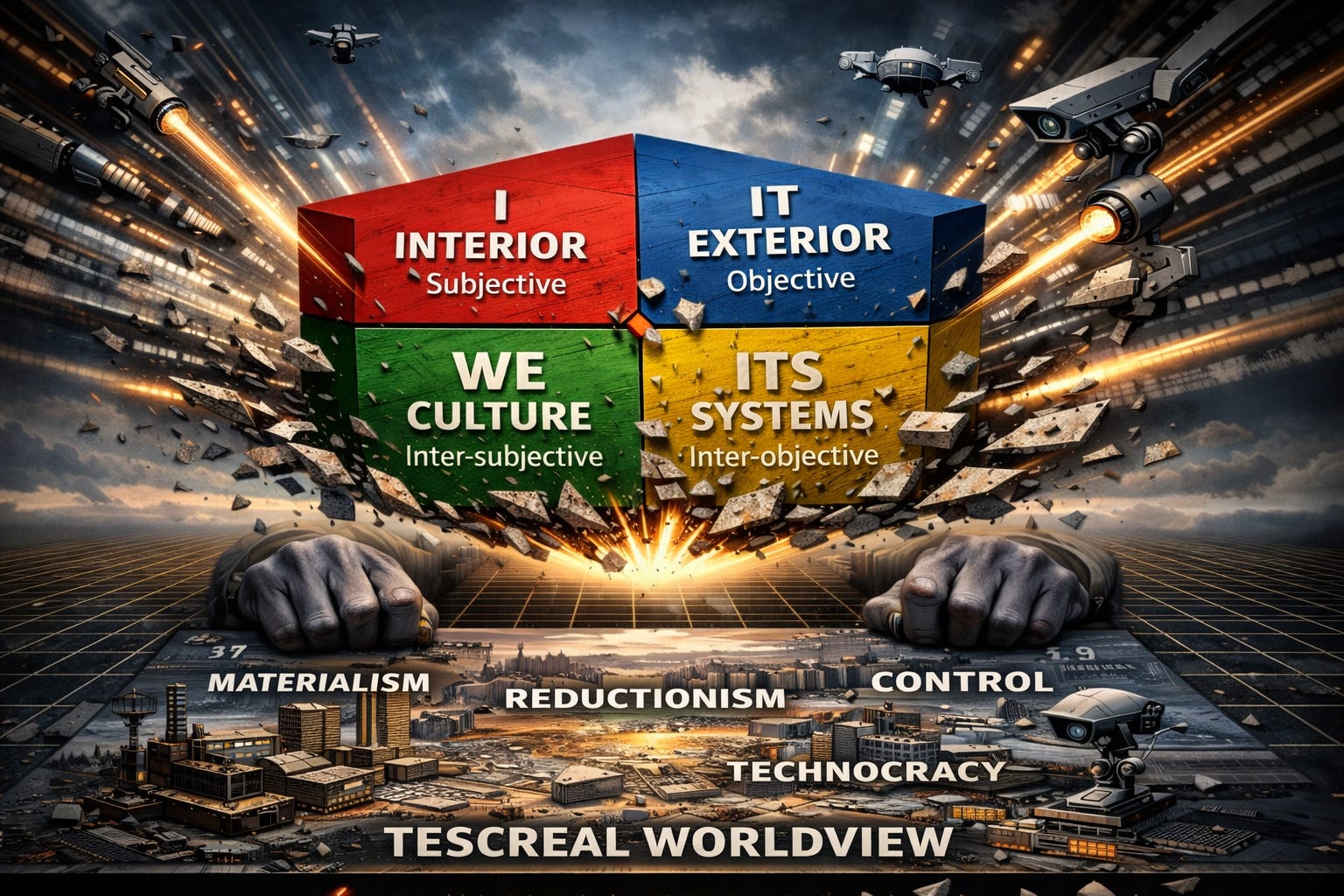
Exterior over interior: what can be measured, built, and optimized matters more than subjective inner experience.
Progress as linear and inevitable: humanity is on an upward technological trajectory, and the goal is to accelerate it.
The universe as a resource: even cosmically, the long-term vision involves colonizing and utilizing the universe for maximum computational capacity.
In its attempt to avoid vulnerability and maintain optimal control, the TESCREAL worldview wages a war on interiority, and in doing so, flattens reality itself.
The Post-Conventional Shift
The TESCREAL ideology is modernity taken to its extreme conclusion. And whether or not we subscribe to its extreme form, we are all embedded in this system of extraction. The irony is that as AI becomes increasingly capable of doing more of our work, what will remain most distinctly human is precisely what this worldview dismisses — the qualitative depths of our interiority.
In writing this, I recognize it is unlikely to change the minds of those committed consciously or unconsciously to a TESCREAL worldview. At the same time, I regularly encounter people going through a profound shift — moving from being willing participants in the modern system to becoming disillusioned and acutely aware of its limitations.
Perhaps you are going through such a shift yourself, walking the post-conventional path that seeks to move beyond the chains of modernity. If so, stay true to what you know in your heart
Recognize where you may still be at war with yourself — becoming aware of inner terrain you’re scared to traverse. Embrace the letting go, the dying away of what no longer serves life on Earth.
Allow your introspection to deepen into contemplation — one that reveals inner and outer as false dichotomies. One that opens space to meet unbearable suffering with inexhaustible compassion — a perspective that does not seek to flatten reality, but to know it in its boundless wholeness.
Thanks for reading. If you enjoyed this read click the “subscribe now” button below to subscribe. If you're already a subscriber click the “share insighter” button to share with a friend or the “leave a comment” button to share some thoughts.